Loading
m.
Downloading canvas…
// waking the cursors
Loading
Adult children in Saudi Arabia manage a parent's chronic medications, often four to eight drugs from several doctors, with a WhatsApp group and memory.
Self-initiated concept · iOS · Arabic-first
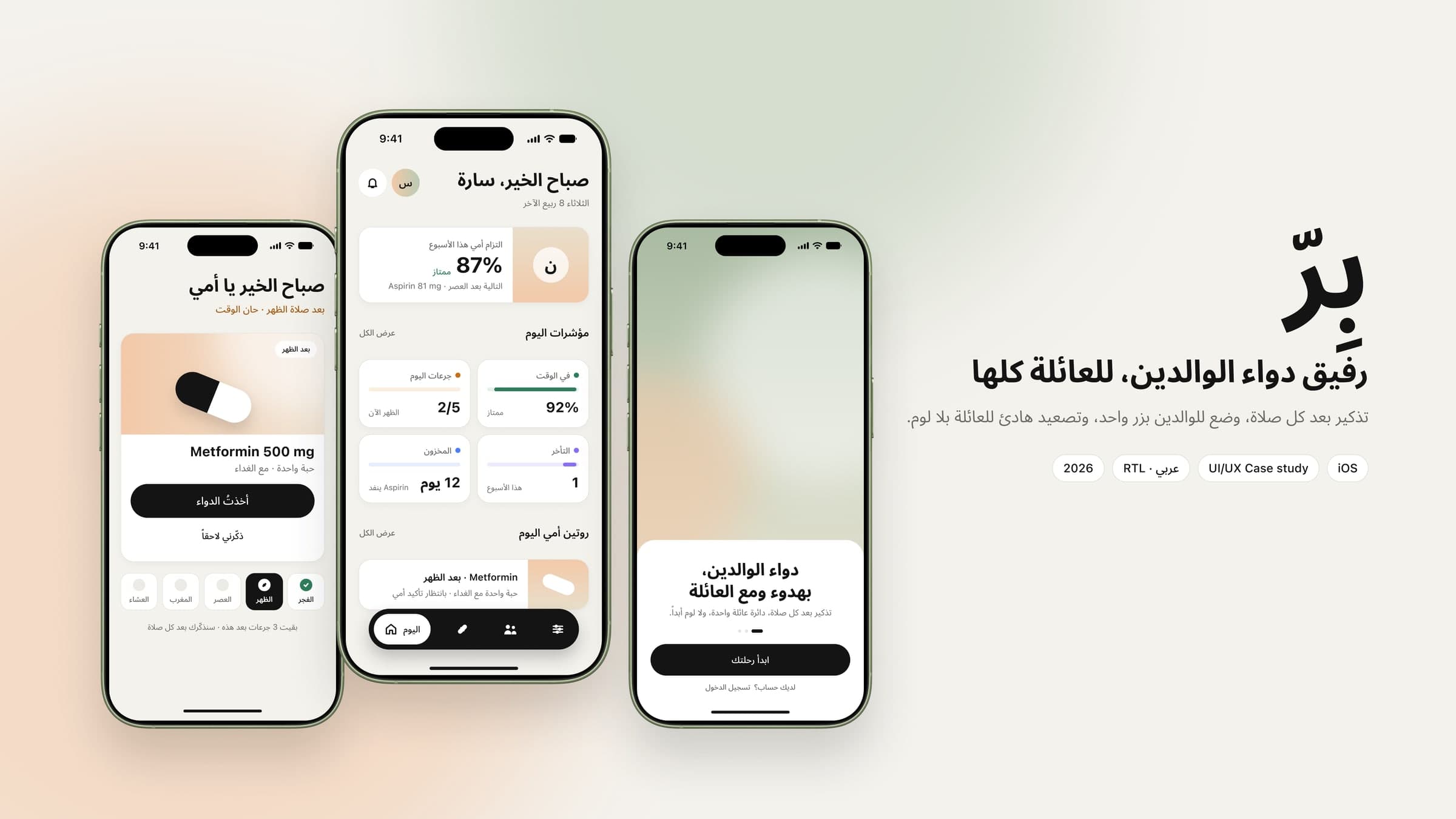
بِرّ is birr al-walidayn, the duty of kindness to your parents. I help manage my parents' medication, and the project started with one question: why is this so hard? Three things shaped the answer.
 // preview
Two households · both sides
Nothing here was commissioned. I'm inside the problem myself, and so is a friend, which gave me two households to study from both sides. I interviewed my friend Abdulrahman and all four parents, kept a three-day diary of my own household, audited three apps, and tested a prototype with five people. Small numbers, real people.
Medisafe · Sehhaty · Nahdi
The three apps a Saudi family most likely already has: the best-known reminder app, the national health platform, and the biggest pharmacy chain's app.
Five insights
Five insights drove every decision that follows. Four came straight out of the interviews. The fifth I expected, and the interviews sharpened it.
Participant voices
“I gave him the evening one, then my sister came home and gave it again. Nobody wrote anything down.”
“I only know it's finished when I open the box and there's nothing in it.”
“If it has a password, I'm not using it.”
Who it's for · jobs · scope
Four rules
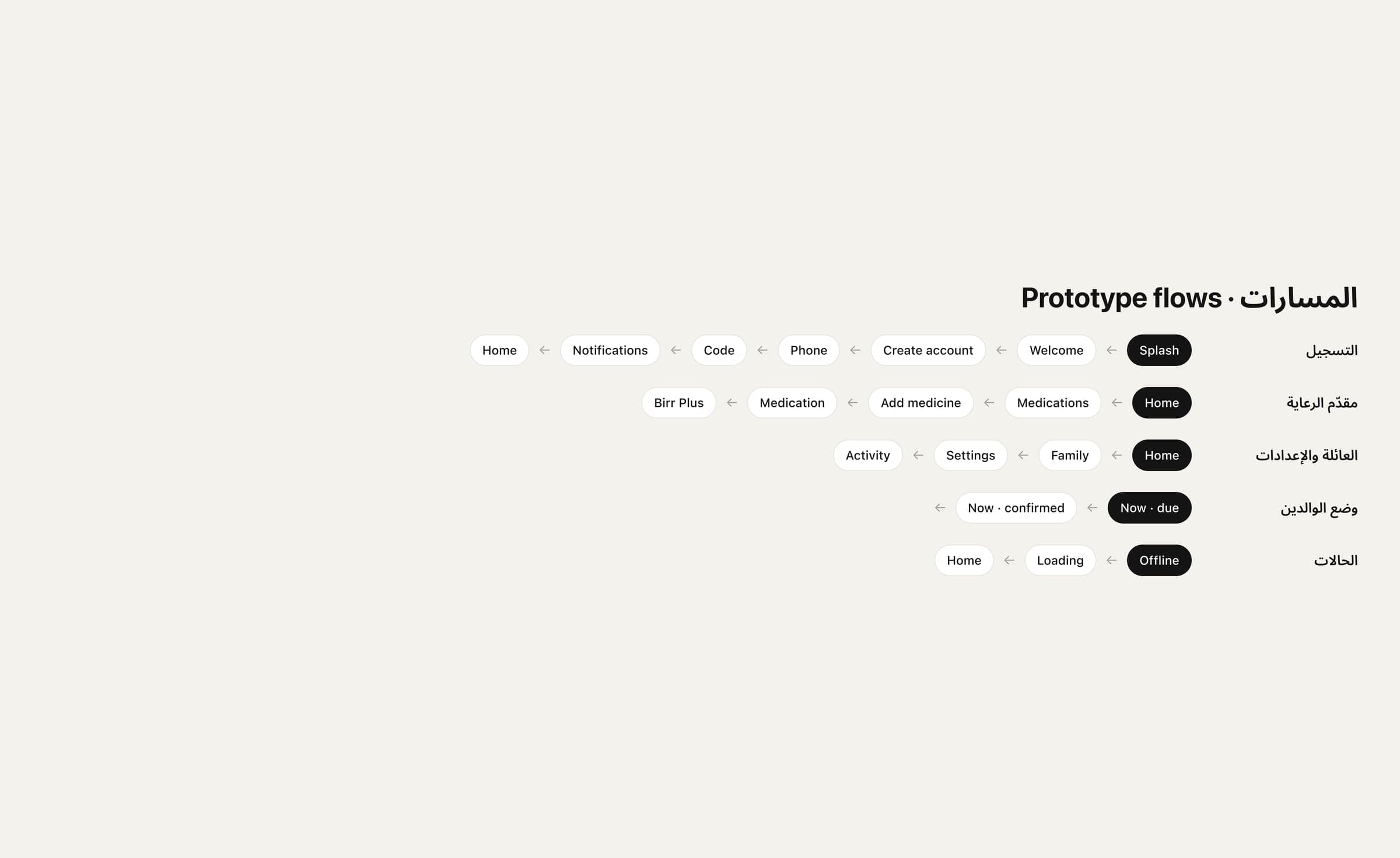
Information architecture
 // preview
 // preview
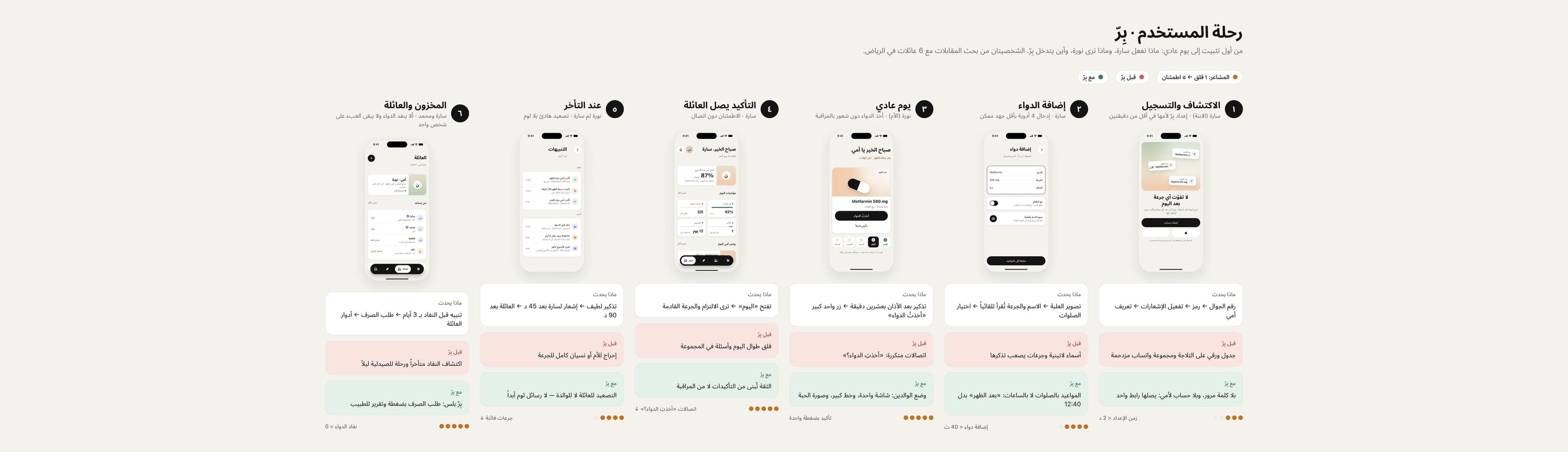
Six steps
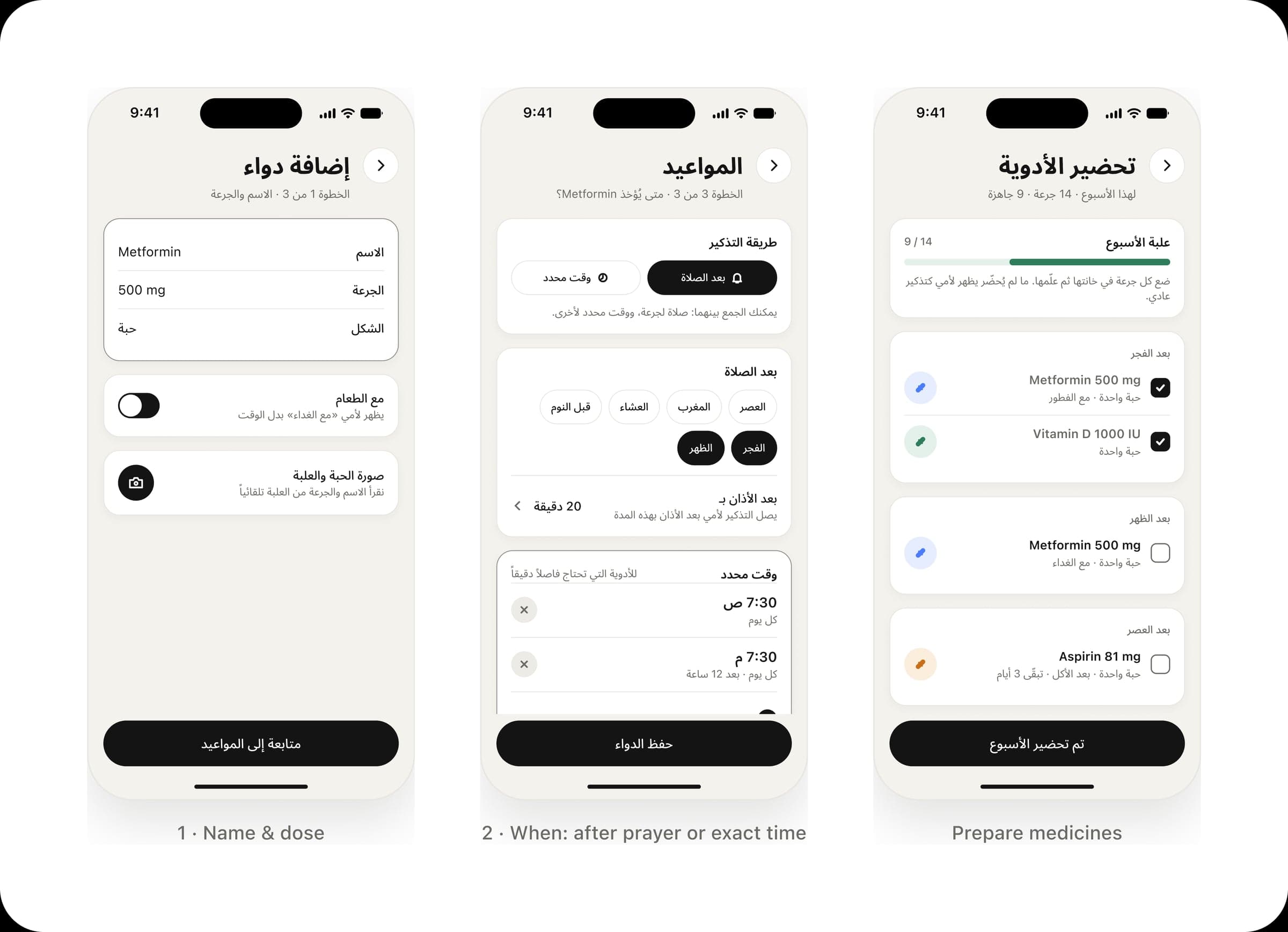
Problem · decision · trade-off
Each one has the same shape: the problem, what I did, and what it cost.
 // preview
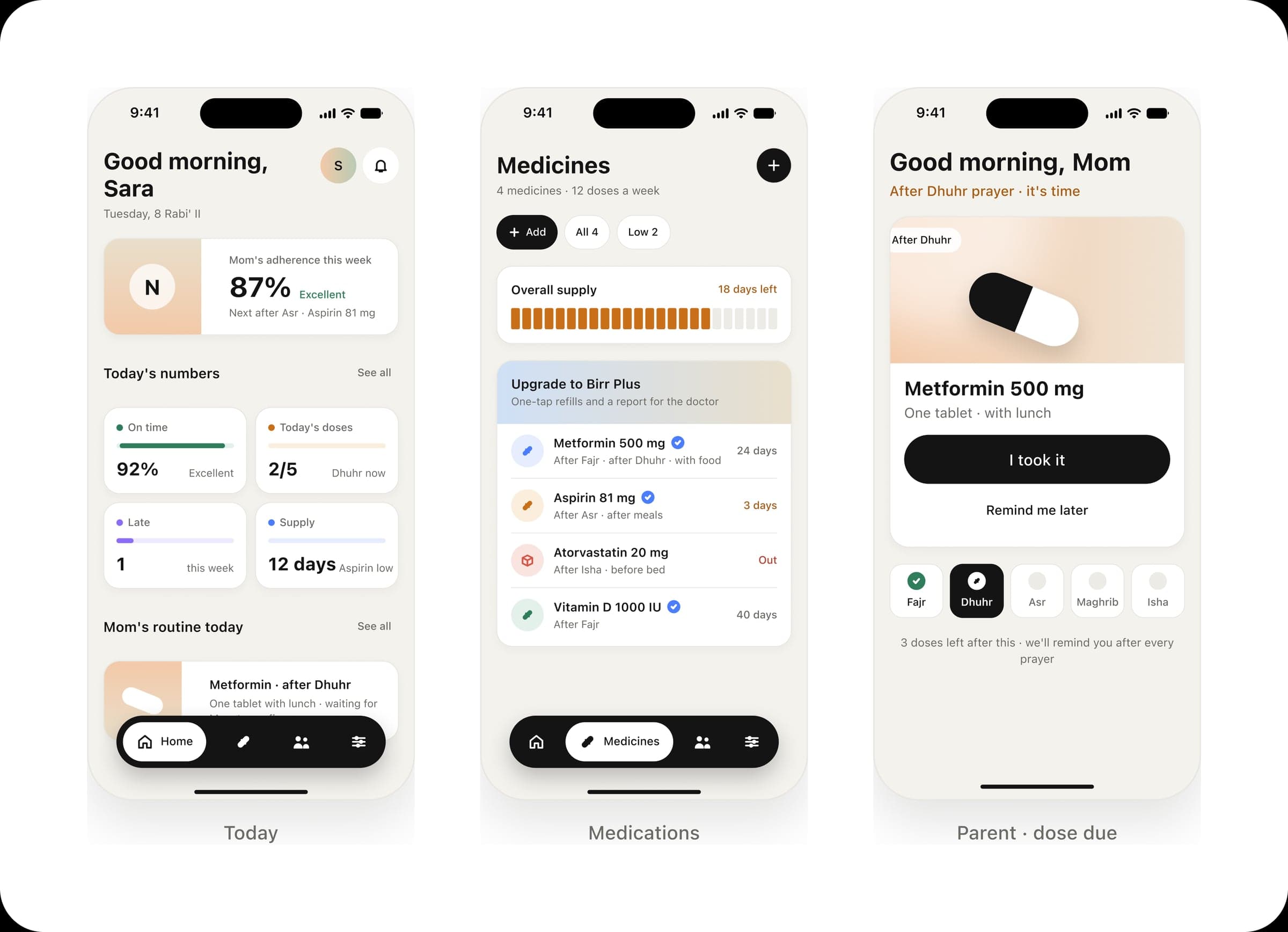 // preview
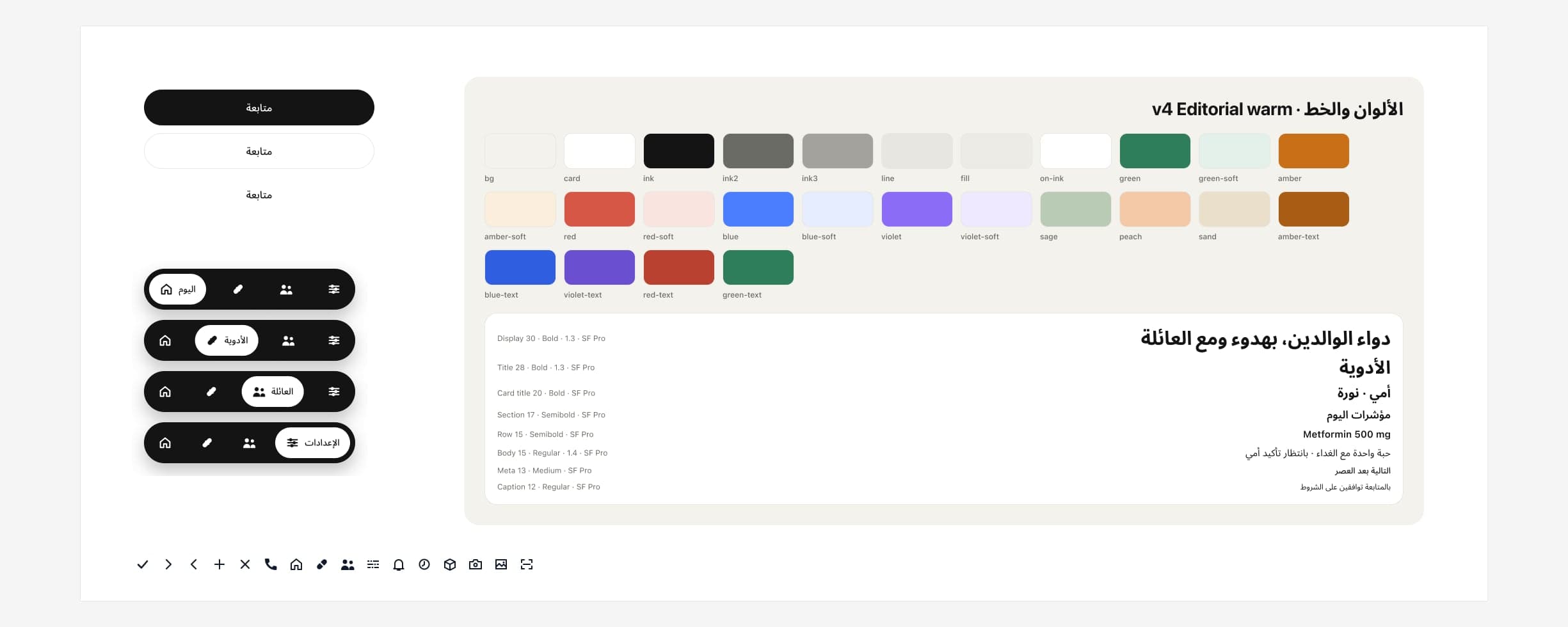
Direction · colour tokens
Calm, warm and high-contrast, borrowed from editorial apps rather than health apps: a warm ivory canvas, white cards with a hairline, generous corners, a floating black tab bar and one black pill for the primary action. Colour is kept for meaning: amber for running low, green for confirmed, red only for out of stock. The parent side is bigger, plainer and slower.
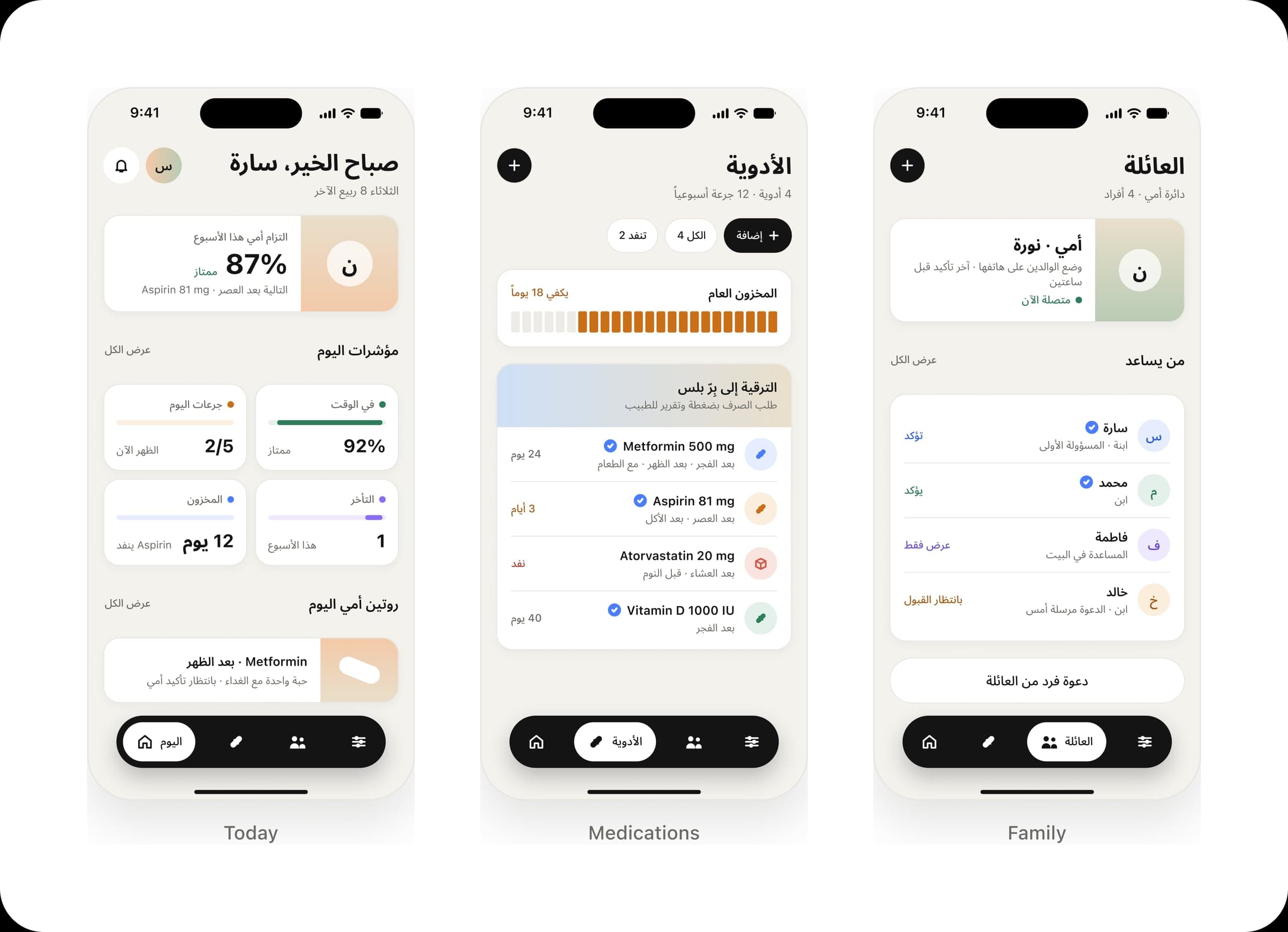 // preview
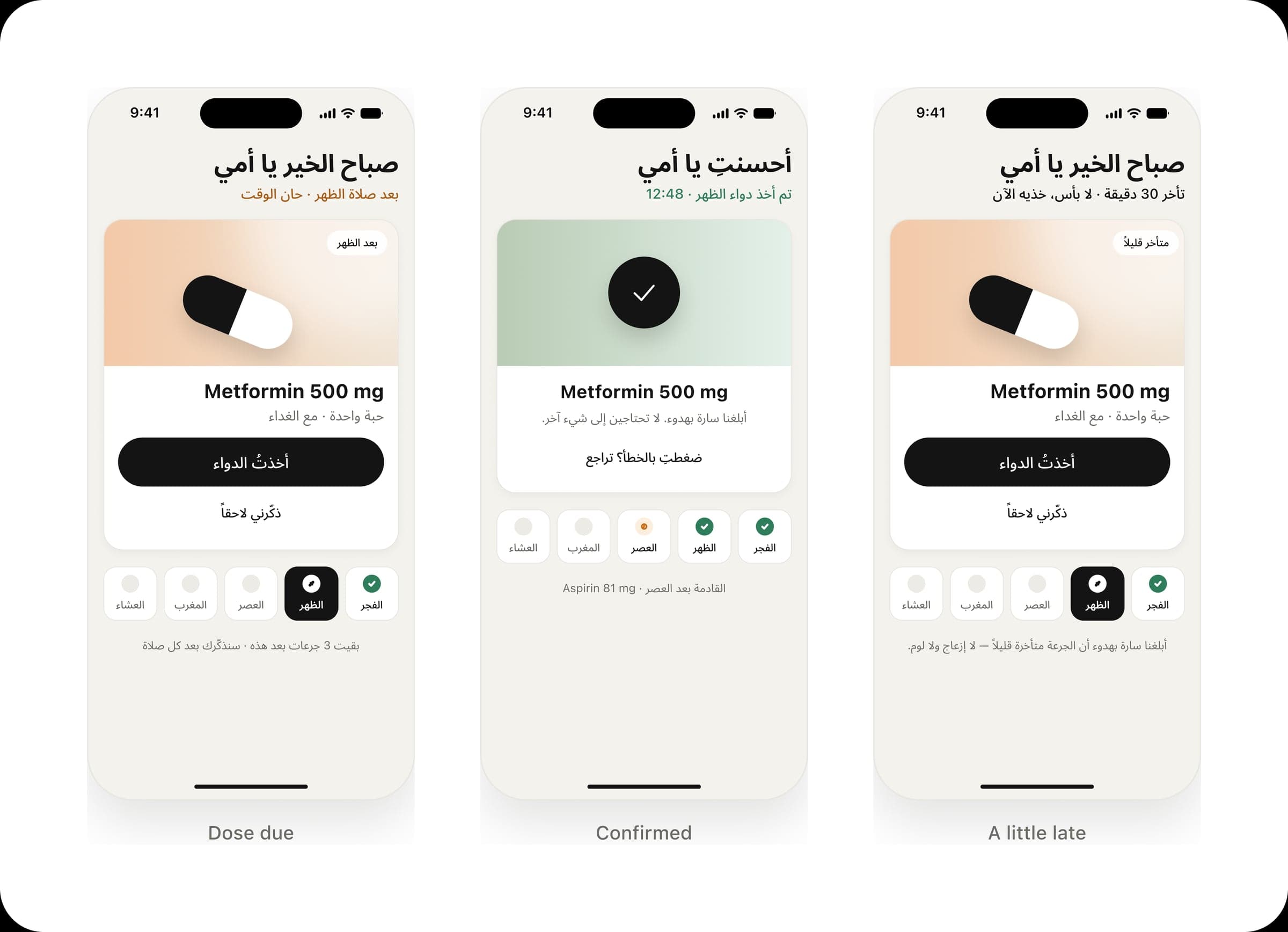 // preview
One family for both scripts
SF Pro for both scripts, Regular to Bold, so a mixed line (an Arabic sentence with a Latin drug name) sits on one baseline without a seam.
 // preview
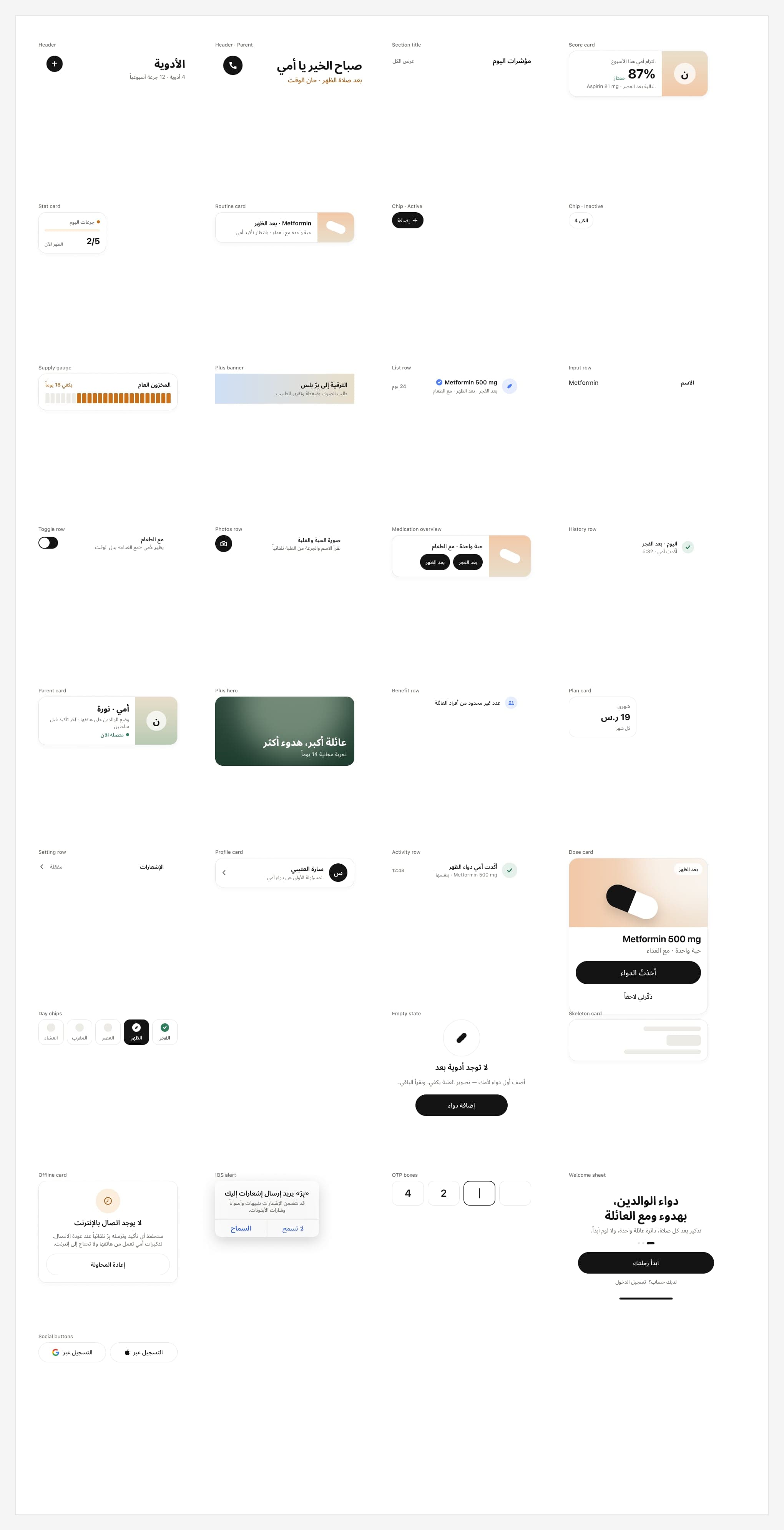
32 components · 17 icons
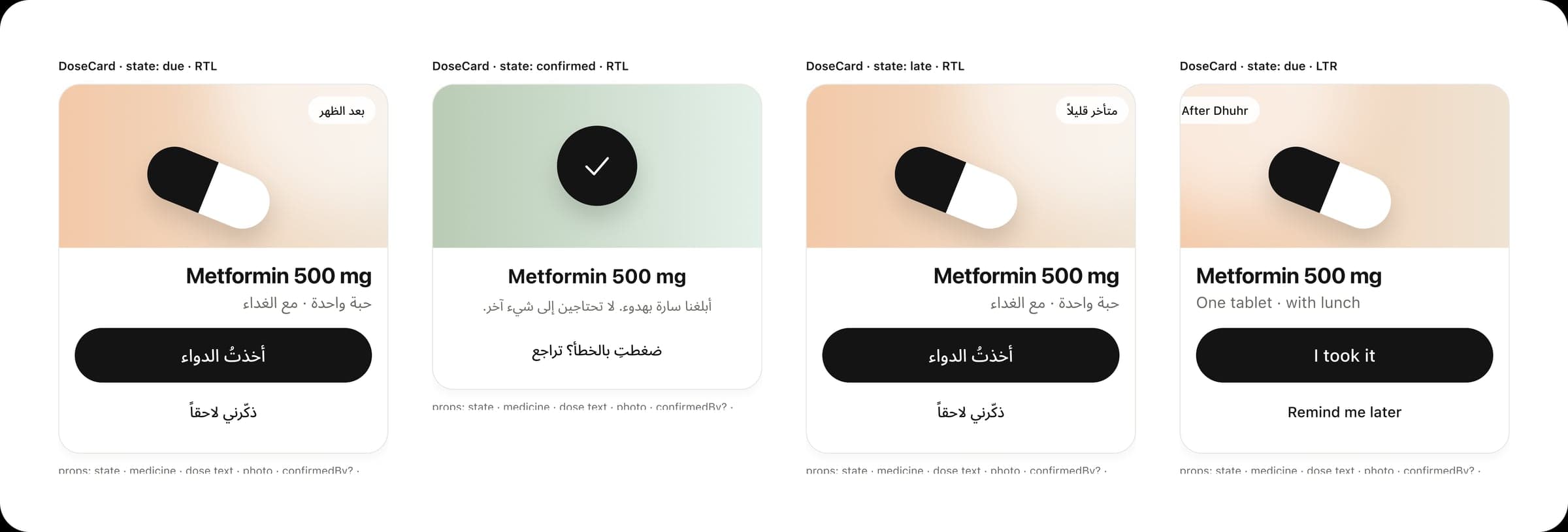
32 components built from the screens, plus the Button and Tab bar variant sets and a 17-icon set. The ones that carry the product:
 // preview
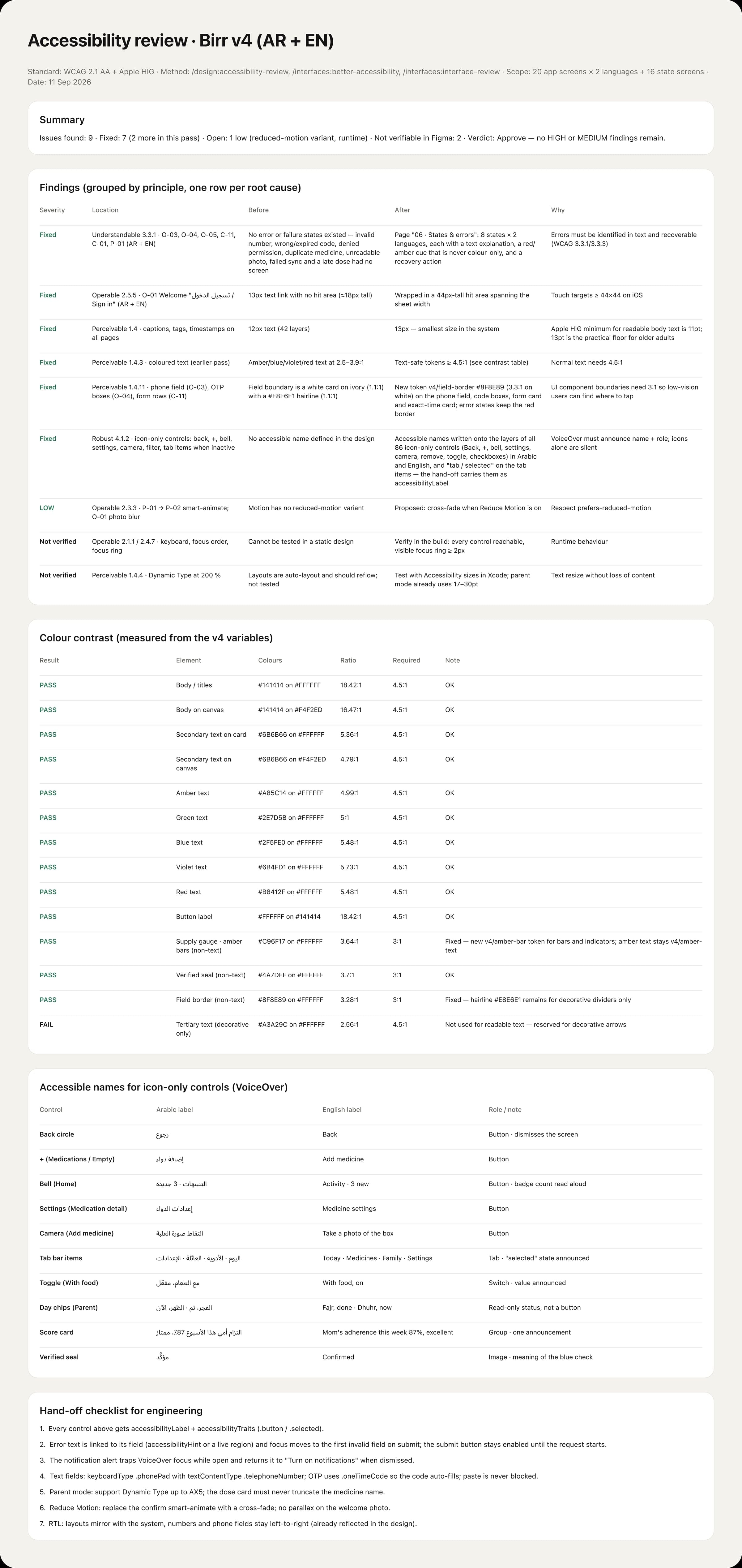
WCAG 2.1 AA · Apple HIG
Audited against WCAG 2.1 AA and Apple's HIG before hand-off, with contrast measured from the actual variables.
 // preview
SUS 84 (n = 5)
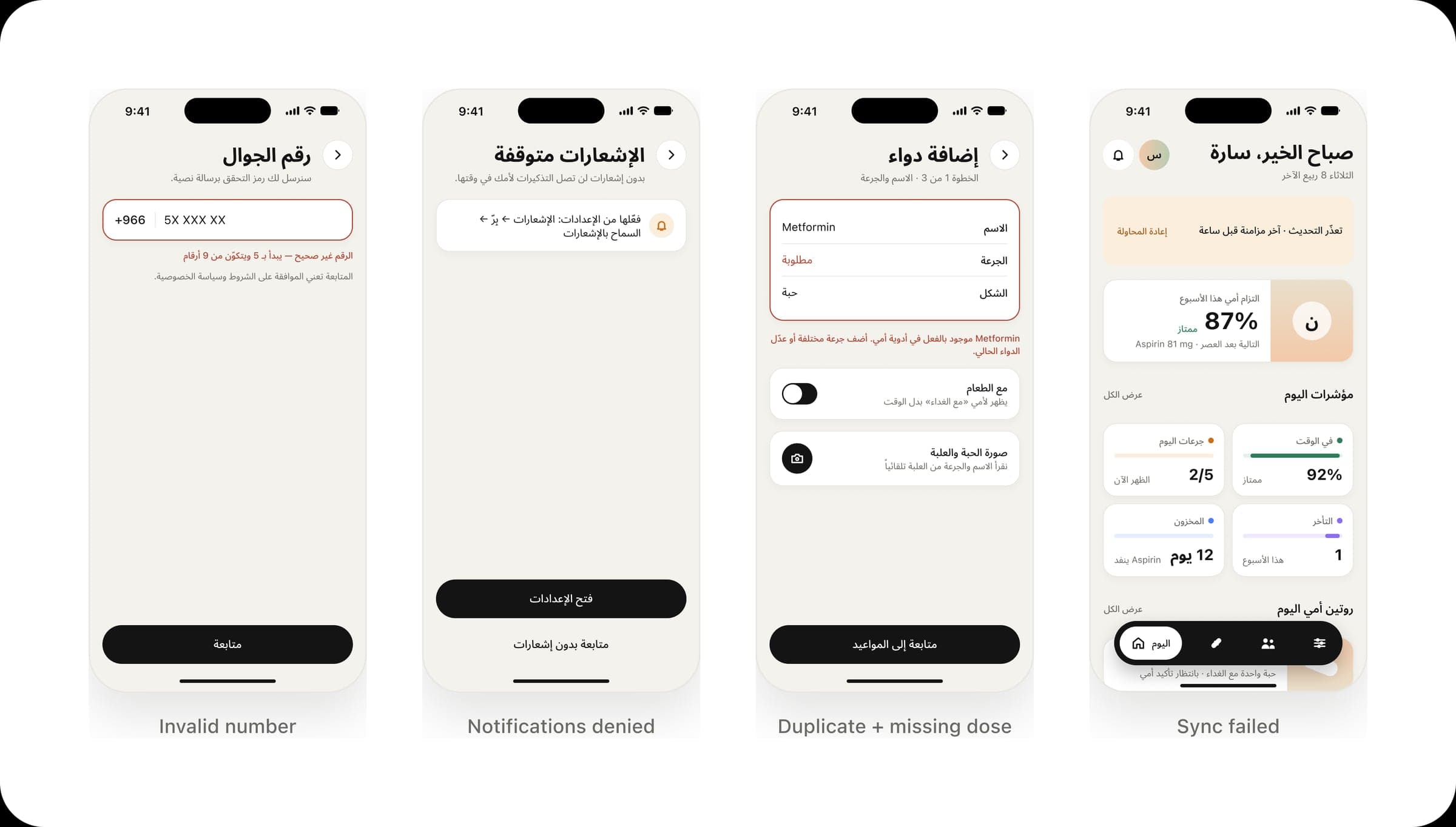
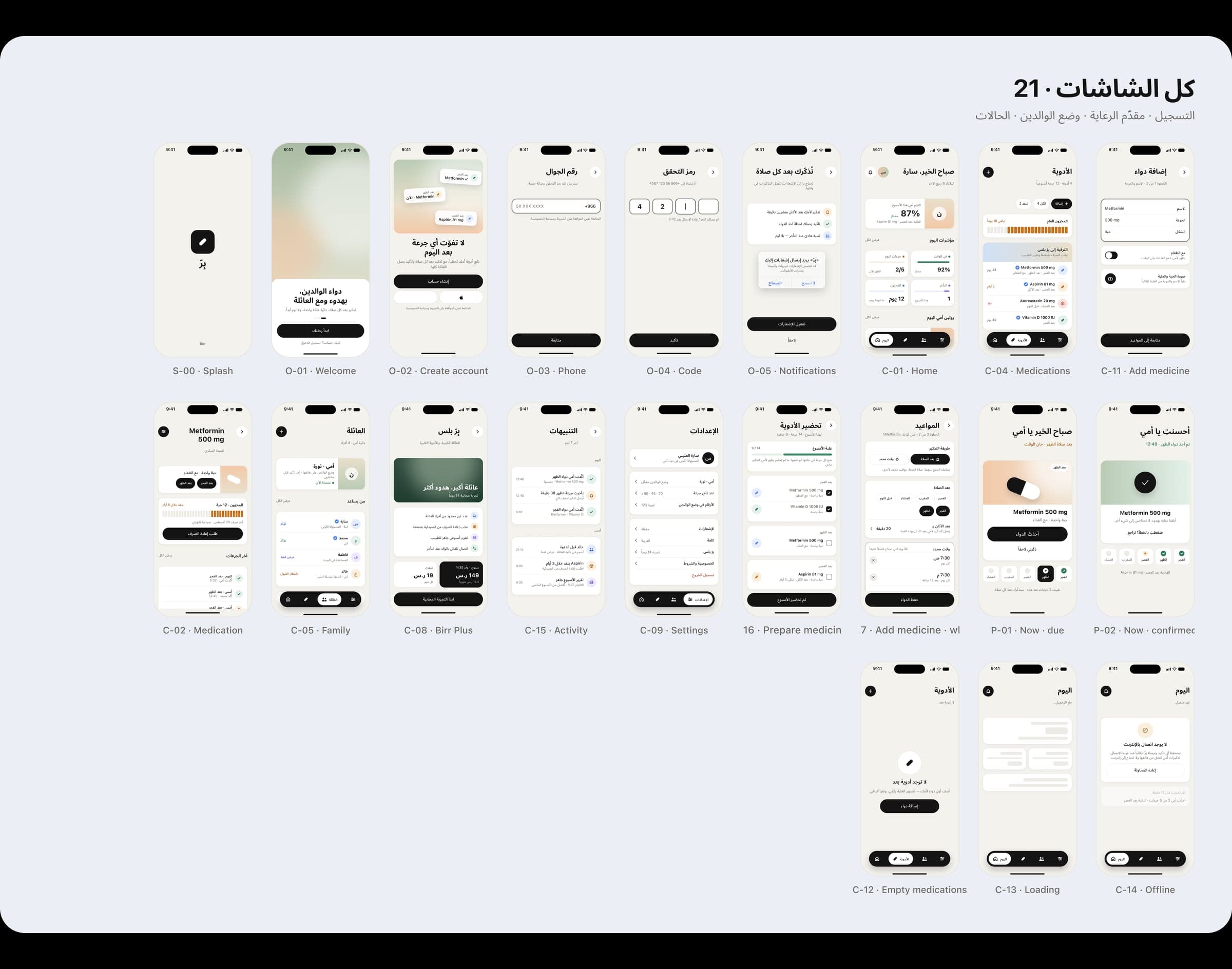
Figma, both modes, Arabic and English: 21 screens per language plus 8 error states, linked as four flows. Five people tested it: two caregivers (Abdulrahman and my brother, who hadn't seen the design) and three parents (Munirah, Mutlaq and Nora). The parents are the same people I interviewed. A household I didn't know would have been better, and I couldn't get one. I measured completion, time on task, errors, a confidence rating per task, and SUS at the end.
 // preview
 // preview
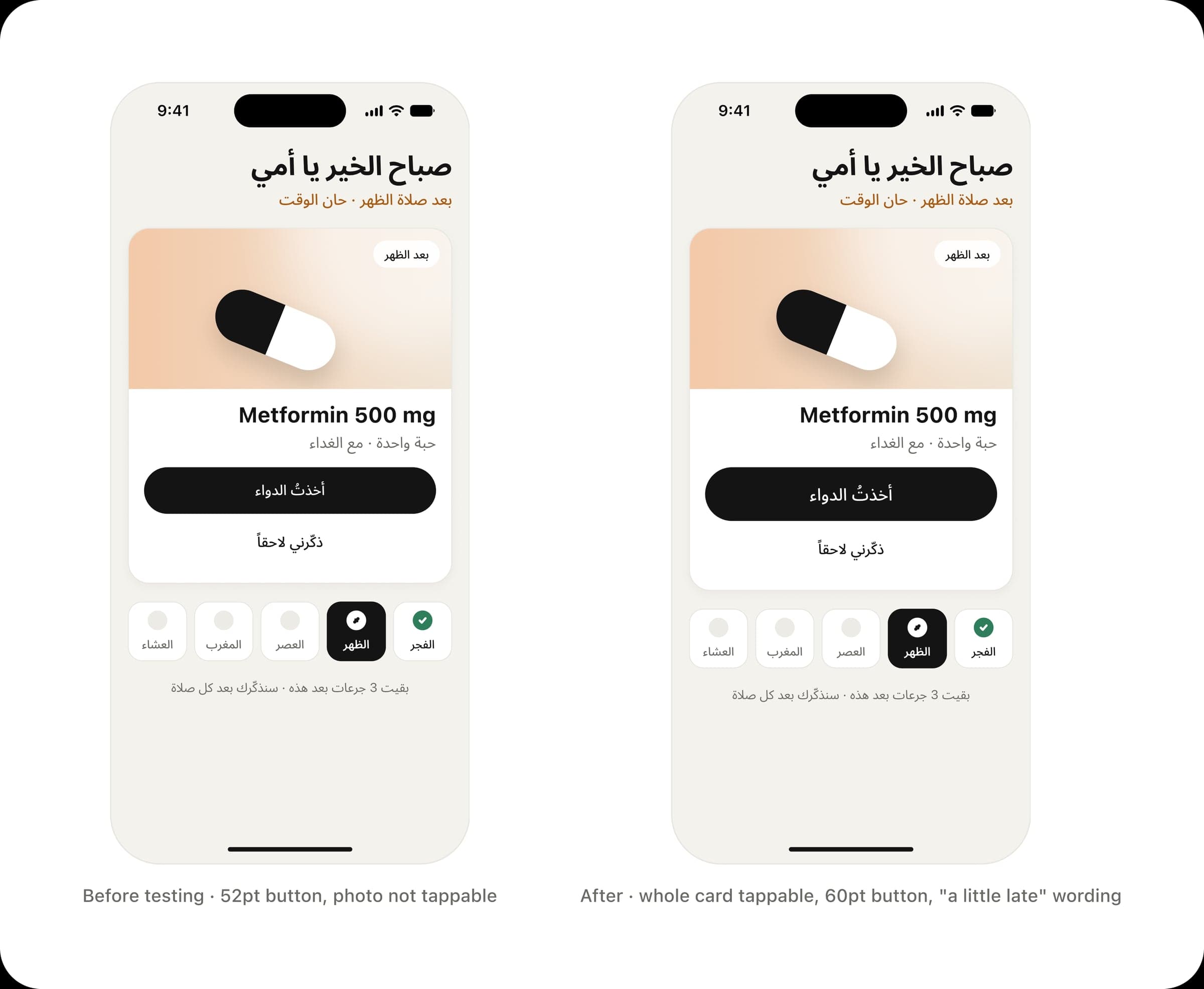
After testing · before testing
The prototype scored 84 on the System Usability Scale (n = 5). Three changes came out of testing. The rest came earlier, from my own review.
 // preview
For the engineer who builds it
A design system is only real when it survives a codebase, so the handoff was written for the engineer who builds it, with the RTL and localisation rules spelled out.
 // preview
Concept outcome · if this were real
All five participants completed the core tasks. Both caregivers called prayer-time scheduling “finally”, unprompted, and my father asked when he could have it on his phone. After launch I'd measure on-time dose rate, refill-on-time rate, unconfirmed-dose rate over time, and weekly active caregivers per circle.
Closing
Get in touch for the full walkthrough, or browse the rest of the work.